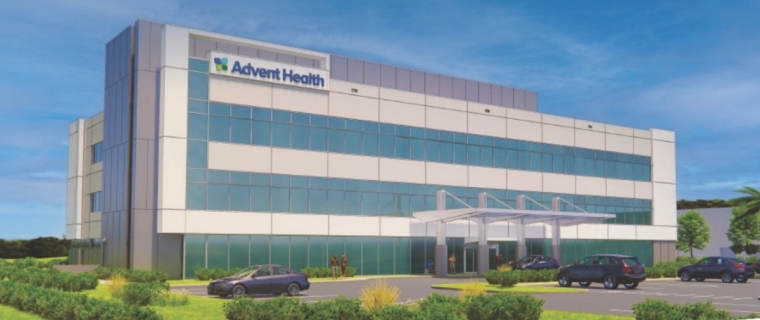
The new medical office building will join several other ongoing medical services development projects in Ocala.
The new medical office building will join several other ongoing medical services development projects in Ocala.
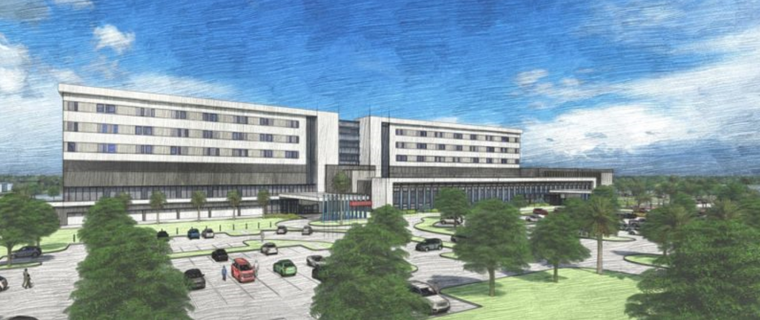
More than 800 hospital employees and 250 physicians will work at the new 424,000-square-foot facility. The facility includes an 85,000-square-foot medical arts building.
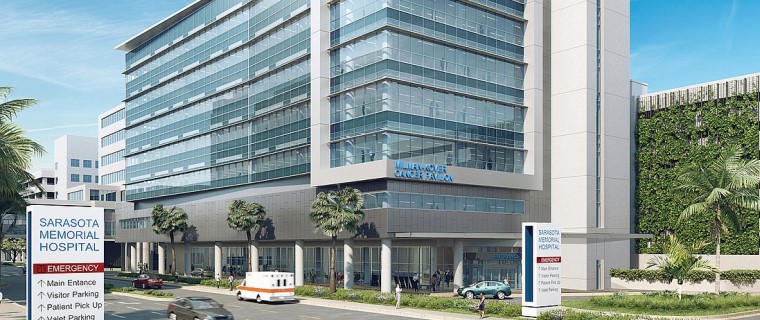
A recent $16M donation will be used to build an expanded breast health center as part of Sarasota Memorial’s Jellison Cancer Institute.

In 2021, Alabama construction firm Robins & Morton opened an office in Tampa, its third in Florida, to serve the growing demand for hospital construction here. The firm had seen requests for proposals triple from 2019 to 2020. The company’s health care revenue from Florida grew 30% in a four-year span.
Credit the gains to a substantial trimming of Florida’s certificate of need requirement in 2019. The action has produced a surge in health care construction around Florida.
“Since (the) Florida Legislature repealed part of the certificate of need law several years ago, we have seen increased demand for health care construction across the state, especially in acute care and specialty care facilities,” says Derek Gregg, a Robins & Morton vice president based in the firm’s Orlando office.
The certificate of need process required hospitals, home health care agencies and other providers to demonstrate that a new facility or service was needed and wouldn’t take business from existing players.
In Florida and other states, the law dated to the 1970s once the federal government made a certificate of need program a condition of receiving federal funding. The idea was to contain health care costs by preventing unneeded equipment and facilities. Guaranteeing existing players a market — they could object to a competitor’s application to expand — also was intended to subsidize indigent care.
Congress repealed the mandate in 1986, but certificate of need — much loved by entrenched providers — lived on in Florida and other states. That changed over time. A U.S. Federal Trade Commission study found certificates of need generally didn’t contain costs. Benefits provided were outweighed by the anti-competitive costs.
Florida got rid of certificates of need for home health agencies in 2000. In 10 years, the number of agencies doubled. Repeal of the requirement on other health care services followed. Then in 2019, the Legislature abandoned certificate of need for hospitals.
In the four years up to that point, the dollar value of hospital construction in Florida was $5 billion, according to data from Richard Branch, chief economist for the Bedford, Mass.-based Dodge Construction Network. In the four years following the repeal, the total reached $6.5 billion.
Health care systems expanded to gain market share in their regions and new regions of the state while out-of-state players planted flags here. A larger geographic footprint gives systems more leverage in negotiations with insurers. Where they located came down to “where the money is,” says Steven Ullmann, a professor in the Department of Health Management and Policy at the Miami Herbert Business School at the University of Miami. Thus, Palm Beach County has seen entrants from Broward, Miami-Dade, the northeast U.S. and Tampa while the surge bypassed rural and low-income markets.
From 2020 to 2022, healthcare companies announced at least 65 new hospitals in Florida, KFF HealthNews reported last year, up from 20 new ones from 2016 to 2018.
The dollar value of Florida hospital construction peaked in 2020 at $1.8 billion, more than double the annual figure from 2016, according to Dodge. Since then, new construction has remained above pre-repeal levels but has ebbed and flowed. Robins & Morton reports that the number of requests for proposals it’s receiving has stabilized.
The University of Miami’s Ullmann says that’s to be expected. “There’s only so much market out there.”
Even so, hot pockets of hospital development remain. In Plant City in eastern Hillsborough County, BayCare Health Care is replacing a 71-year-old hospital that has run out of room to expand any further. Since opening in 1953, the old South Florida Baptist Hospital has been expanded or renovated a dozen times, but it has maxed out its property and the Plant City area’s population keeps growing. So BayCare is building an entirely new South Florida Baptist Hospital that’s 68% bigger four miles away.
BayCare, which operates 16 hospitals in Pinellas, Hillsborough, Pasco and Polk counties, also is planning a 17th hospital in northern Manatee County. BayCare Hospital Manatee is slated to open in 2027. The building itself is currently in the design phase, so square footage and number of patient rooms are not finalized. The building permit application requests up to 207 private patient rooms, but the initial construction likely will have a smaller bed count.
HCA Florida Healthcare also has plans to construct a hospital in northern Manatee. The 150-bed hospital will serve as an anchor for the North River Ranch Village Center, a “healthoriented” complex that developer Neal Land & Neighborhoods is planning on 2,000-plus acres in fast-growing Parrish. No set timeline has been announced for the project.
WESLEY CHAPEL HOSPITAL
Wesley Chapel
BayCare Health System opened its $246-million Wesley Chapel hospital in 2023. It’s one of a slew of facilities that have sprung up across the state since the Legislature deregulated new hospital construction.
ALAN B. MILLER MEDICAL CENTER
Palm Beach Gardens
Universal Health Services broke ground last year on a 150- bed hospital in Palm Beach Gardens. The Alan B. Miller Medical Center, named for the founder and executive chairman of UHS, is sla1ted to open in 2025. UHS also owns the Wellington Regional Medical Center.
ORLANDO HEALTH WIREGRASS RANCH HOSPITAL
Wesley Chapel
Orlando Health is expanding its hospital footprint across I-4, with facilities slated for fast-growing portions of Pasco and Polk counties. Construction is underway in southeast Lakeland on Orlando Health’s 302-bed Lakeland Highlands Hospital, with an opening anticipated in 2026. Orlando Health is continuing site work for its 300-bed Wiregrass Ranch Hospital in Wesley Chapel. An opening date has not been announced.
SOUTH FLORIDA BAPTIST HOSPITAL
Plant City
The original South Florida Baptist Hospital had 250,000 square feet and few private rooms. Its $326-million replacement will have 420,000 square feet, six floors and 146 private rooms.
For Some, Permission Slips Still Apply
While Florida jettisoned its certificate of need process for hospitals in 2019, nursing homes, freestanding hospice facilities and other types of long-term care facilities still require the state’s stamp of approval. Florida is one of only 13 states, in fact, that regulates hospice services via a certificate of need process, according to a 2023 Florida TaxWatch report.
Source: Florida Trend
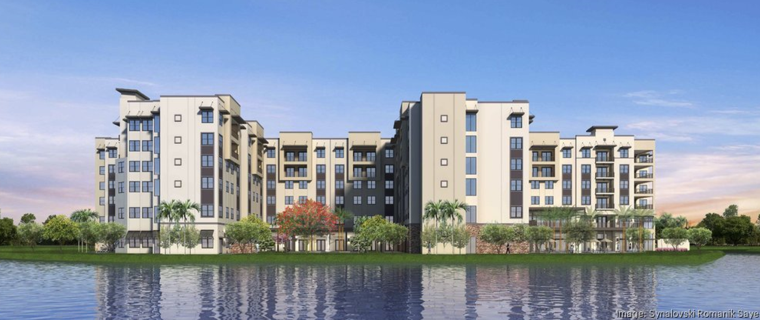
In Weston, a developer is requesting permission to build a six-story assisted living complex.
On April 15, the City Commission will take a look at the site plan and rezoning request for the 6.17-acre property located at 357 Racquet Club Road. The property’s rezoning application was initially presented to the City Commission in January, but it lacked a site plan that detailed the detailed development strategy. This is the first vote on the site plan and the second reading for the rezoning.
SREH-357 Racquet Club LLC, managed by Terry Salzman of Salzman Real Estate Advisors in Dania Beach, claimed in their most recent site plan application that the facility would have 245 senior housing units totaling 303 beds and 325,808 square feet. There would be 113 independent living units, 108 assisted living units, and 24 memory care units. A wide range of senior living amenities would be included, including a game room, eating area, theater, garden, exercise center, library, and swimming pool. The project would contain 200 parking places, based on the site plan. The sizes of the rooms would be 546 to 1,330 square feet.
The developer is requesting that the property be rezoned from “commercial” to “mid-rise multifamily.” Currently, it houses a 9,000-square-foot facility that was formerly the management office and welcome center for the nearby Vacation Village timeshare complex, which was built in 1975.
Fort Lauderdale-based Synalovski Romanik Saye designed the project.
Source: SFBJ