Older Medical Buildings Are Finding New Life In Florida’s Healthcare Real Estate Market
As healthcare providers continue to expand across Florida, some of the most interesting opportunities in medical real estate may not involve new construction at all.
Existing healthcare properties—particularly buildings that have already supported physicians, specialty practices and other clinical uses—are increasingly candidates for redevelopment and repositioning. Instead of replacing aging medical buildings, owners can sometimes adapt them for a new generation of healthcare tenants.
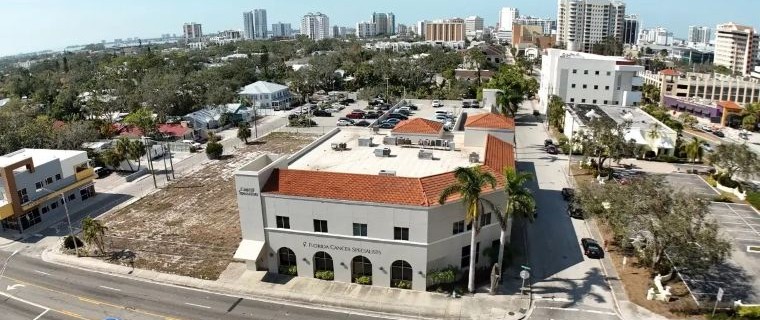
A recent example is unfolding in downtown Sarasota, where a property that housed Florida Cancer Specialists for decades is being repositioned as a multitenant medical office building. The transition illustrates how a building developed around a single healthcare user can potentially remain part of the medical real estate inventory even after that tenant’s needs change.
That can be particularly valuable in Florida, where demand for outpatient healthcare continues to expand while developing new medical facilities remains costly and time consuming.
An existing medical property may already contain some medical infrastructure—or at least have building systems capable of supporting it. That creates the potential for owners to reposition older healthcare assets rather than starting with conventional office space or pursuing ground-up development.
Location can make redevelopment even more attractive.
Medical practices depend heavily on accessibility, parking, visibility and proximity to the patients they serve. Older medical buildings are frequently located in established areas where surrounding residential density and healthcare demand are already in place. In some cases, those characteristics may be difficult to reproduce with new development.
Converting a former single-user facility into a multitenant medical property can also broaden the building’s potential tenant base. Instead of relying on one large healthcare organization, an owner could accommodate a combination of primary care physicians, specialists, therapy practices, diagnostic providers and other outpatient users.
That model reflects a larger change in healthcare delivery. More services are being provided outside traditional hospitals, creating demand for facilities ranging from small physician offices to specialty clinics and ambulatory care locations.
For investors, the opportunity requires careful evaluation. An older medical building still needs modern mechanical systems, sufficient parking, appropriate accessibility and floor plans that can accommodate contemporary healthcare operations. Some properties will require substantial capital improvements before they can compete effectively.
But buildings with strong fundamentals may have an important advantage: they already have a history of healthcare use.
As Florida’s population grows and providers look for additional locations, redevelopment could become an increasingly important part of the state’s medical office market. New medical buildings will continue to be developed, but the next generation of Florida healthcare real estate may also include older properties being adapted to serve new providers, new specialties and new models of outpatient care.
For more information contact us:
954.346.8200 x 201

