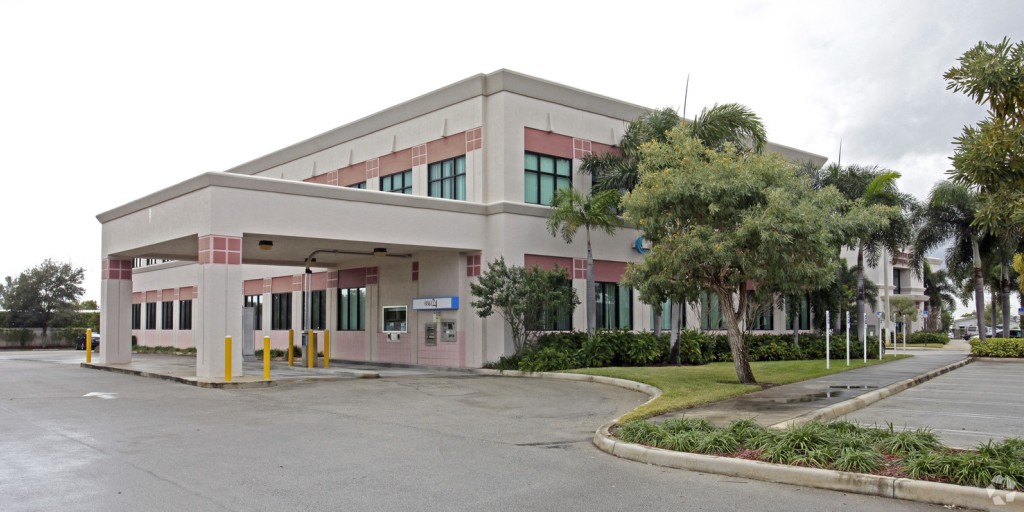
Avison Young completed the $5.5 million sale of Boynton West Professional Centre, a set of twin buildings totaling 32,593 square feet at 1700-1800 West Woolbright Road in Boynton Beach.
Avison Young Principals Mark Rubin and Gary Gottlieb represented the seller, Hews Woolbright, LLC, in the disposition to TopMed Realty Acquisitions, LLC.
At 80 percent leased with medical and professional tenants, Boynton West Professional Centre was a value-add opportunity strategically located just half a mile west of Interstate 95, proximate to the JFK Medical Center, Bethesda Hospital, restaurants, and retail.
“We were initially retained by our client to provide full-service leasing and management to ultimately market and sell the property,” said Rubin. “The leasing and management teams led by Gary Gottlieb, stabilized the asset by securing lease renewals, increased occupancy by 20 percent, and oversaw valuable property improvements, allowing us to achieve leading market prices in an accelerated timeline. We secured an aggressive buyer who was attracted to the highly visible and easily accessible location of the property and the potential to lease it up with strong medical tenants.”
According to Avison Young’s second quarter 2018 Palm Beach County office market report, demand remains strong in Boynton Beach with no new development in the pipeline (and the same for several surrounding submarkets), consistent zero vacancy in class A space, and absorption posting at 22,728 square feet from space leased in class B assets.
At 80 percent leased with medical and professional tenants, Boynton West Professional Centre was a value-add opportunity strategically located just half a mile west of Interstate 95, proximate to the JFK Medical Center, Bethesda Hospital, restaurants, and retail.
“We were initially retained by our client to provide full-service leasing and management to ultimately market and sell the property,” said Rubin. “The leasing and management teams led by Gary Gottlieb, stabilized the asset by securing lease renewals, increased occupancy by 20 percent, and oversaw valuable property improvements, allowing us to achieve leading market prices in an accelerated timeline. We secured an aggressive buyer who was attracted to the highly visible and easily accessible location of the property and the potential to lease it up with strong medical tenants.”
According to Avison Young’s second quarter 2018 Palm Beach County office market report, demand remains strong in Boynton Beach with no new development in the pipeline (and the same for several surrounding submarkets), consistent zero vacancy in class A space, and absorption posting at 22,728 square feet from space leased in class B assets.
According to Avison Young’s second quarter 2018 Palm Beach County office market report, demand remains strong in Boynton Beach with no new development in the pipeline (and the same for several surrounding submarkets), consistent zero vacancy in class A space, and absorption posting at 22,728 square feet from space leased in class B assets.
Source: CRE-sources
The Miami Heat and Baptist Health South Florida have reached a first-of-its-kind partnership for both organizations, as they broke ground on a new health care center.
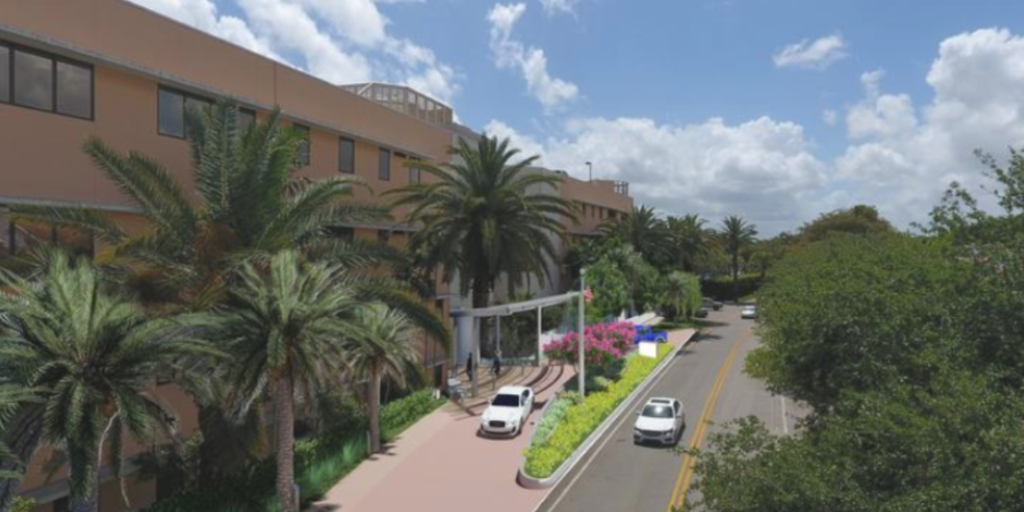
The Miami Heat Sports Medicine Center at the Miami Orthopedics & Sports Medicine Institute is part of a multiyear partnership between the NBA franchise and the nonprofit health system. Renovations will start at 1150 Campo Sano Ave., next to Doctors Hospital in Coral Gables, to create a four-story, 49,000-square-foot facility for advanced sports medicine. It should be open in summer 2019.
The Heat made an unspecified donation to support the expansion.
“Throughout our history, Miami Heat players and staffers have experienced world-class care by the industry-leading medical team at Miami Orthopedics & Sports Medicine Institute,” said Jeff David, executive VP and chief revenue officer of the Heat Group. “Our long-standing and fruitful partnership with Baptist Health has produced The Miami Heat Sports Medicine Center, which will be a guardian of our community’s health and committed to excellence at every level.”
The deal adds a strong branding partner for Baptist Health, the region’s largest hospital system.
The support of the Heat will also allow Baptist Health to expand its orthopedic facility, creating a new ambulatory surgery center and hosting more clinical education.
“This is a truly unparalleled partnership that will make an incredible difference in the future of our Institute, and in the expert care provided to our patients and the community,” Miami Orthopedics & Sports Medicine Institute and Doctors Hospital CEO Nelson Lazo said.
Source: SFBJ
The Heat made an unspecified donation to support the expansion.
“Throughout our history, Miami Heat players and staffers have experienced world-class care by the industry-leading medical team at Miami Orthopedics & Sports Medicine Institute,” said Jeff David, executive VP and chief revenue officer of the Heat Group. “Our long-standing and fruitful partnership with Baptist Health has produced The Miami Heat Sports Medicine Center, which will be a guardian of our community’s health and committed to excellence at every level.”
The deal adds a strong branding partner for Baptist Health, the region’s largest hospital system.
The support of the Heat will also allow Baptist Health to expand its orthopedic facility, creating a new ambulatory surgery center and hosting more clinical education.
“This is a truly unparalleled partnership that will make an incredible difference in the future of our Institute, and in the expert care provided to our patients and the community,” Miami Orthopedics & Sports Medicine Institute and Doctors Hospital CEO Nelson Lazo said.
Source: SFBJ
The deal adds a strong branding partner for Baptist Health, the region’s largest hospital system.
The support of the Heat will also allow Baptist Health to expand its orthopedic facility, creating a new ambulatory surgery center and hosting more clinical education.
“This is a truly unparalleled partnership that will make an incredible difference in the future of our Institute, and in the expert care provided to our patients and the community,” Miami Orthopedics & Sports Medicine Institute and Doctors Hospital CEO Nelson Lazo said.
Source: SFBJ
“This is a truly unparalleled partnership that will make an incredible difference in the future of our Institute, and in the expert care provided to our patients and the community,” Miami Orthopedics & Sports Medicine Institute and Doctors Hospital CEO Nelson Lazo said.
Source: SFBJ
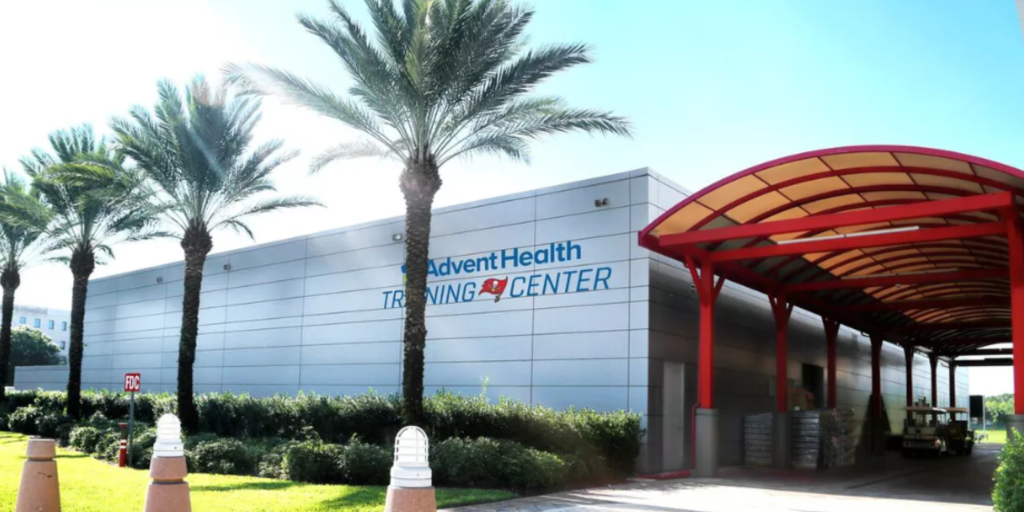
Florida Hospital’s parent company has made a major move to its marketing game plan and has secured naming rights for the Tampa Bay Buccaneers’ new indoor training facility and the team’s headquarters.
The new training center will now be called the AdventHealth Training Center, said Tampa Bay Buccaneers Owner and Co-Chairman Bryan Glazer during a press conference at the Buccaneers headquarters on Monday. The team has been growing the partnership with the parent company over the past six years, he said. Financial terms of the deal were not disclosed.
The naming rights should boost Florida Hospital’s parent company Adventist Health System in its effort to rebrand itself AdventHealth. That officially starts Jan. 2, 2019.
AdventHealth will also have its name on the corporate headquarters at One Buc Place.
“Just as our company is changing, it’s an opportunity for a change in our relationship with the Buccaneers. It’s an introduction to a different [type of] health care,” said Mike Schultz, senior executive vice president at AdventHealth.
The $20 million Buccaneers indoor practice space allows the team to practice through the harsh heat and rain of area summers. Indoor practice facilities are among the hottest new amenities for NFL teams.
The 112,660-square-foot indoor facility is now in its second season of use.
The new indoor facility comes available just as Raymond James Stadium has wrapped up the fourth phase of its $150 million improvement project and will be the venue to host the upcoming Super Bowl LV in 2021.
Source: TBBJ
The naming rights should boost Florida Hospital’s parent company Adventist Health System in its effort to rebrand itself AdventHealth. That officially starts Jan. 2, 2019.
AdventHealth will also have its name on the corporate headquarters at One Buc Place.
“Just as our company is changing, it’s an opportunity for a change in our relationship with the Buccaneers. It’s an introduction to a different [type of] health care,” said Mike Schultz, senior executive vice president at AdventHealth.
The $20 million Buccaneers indoor practice space allows the team to practice through the harsh heat and rain of area summers. Indoor practice facilities are among the hottest new amenities for NFL teams.
The 112,660-square-foot indoor facility is now in its second season of use.
The new indoor facility comes available just as Raymond James Stadium has wrapped up the fourth phase of its $150 million improvement project and will be the venue to host the upcoming Super Bowl LV in 2021.
Source: TBBJ
“Just as our company is changing, it’s an opportunity for a change in our relationship with the Buccaneers. It’s an introduction to a different [type of] health care,” said Mike Schultz, senior executive vice president at AdventHealth.
The $20 million Buccaneers indoor practice space allows the team to practice through the harsh heat and rain of area summers. Indoor practice facilities are among the hottest new amenities for NFL teams.
The 112,660-square-foot indoor facility is now in its second season of use.
The new indoor facility comes available just as Raymond James Stadium has wrapped up the fourth phase of its $150 million improvement project and will be the venue to host the upcoming Super Bowl LV in 2021.
Source: TBBJ
The 112,660-square-foot indoor facility is now in its second season of use.
The new indoor facility comes available just as Raymond James Stadium has wrapped up the fourth phase of its $150 million improvement project and will be the venue to host the upcoming Super Bowl LV in 2021.
Source: TBBJ
Source: TBBJ
Lakeland has been experiencing considerable population growth and development throughout the past decade. This signifies an excellent opportunity for healthcare providers of all specialties to seek new patients bases or expand their current practice. However, understanding the healthcare real estate market, crucial trends in the industry, and the optimal practices in office site selection is crucial in finding Lakeland medical office space that will best position a doctor for success. Whether a client is looking for Lakeland medical office space for lease or for sale, or looking for seller/landlord representation services, Florida Medical space’s professionals are talented and experienced in getting the job done well.
Healthcare Industry Trends
Development and commercial real estate opportunities in Lakeland have presented many avenues for healthcare professionals to benefit from the area’s growth. FMS leverages our experience and expertise to make sure doctors are well-positioned to realize the benefits of practicing in Lakeland.
Shared Medical Office Space
The healthcare industry has seen a sharp rise in shared medical office space for lease. This is because investors recognize the capacity for these buildings to offer prime real estate to doctors and medical groups. We have worked with countless doctors for whom shared medical office space for lease was the correct path to success, but have also seen where a retail or other location was a better choice. We work to take into account all factors that influence this decision for a doctor and play a consultative role throughout the entire process.
Convenience
Another new trend in healthcare is the budding popularity of convenient, consumer-facing practice locations. Each year, an increasing amount healthcare practices are adapting to the evolving demand of patients, seeking prime visibility, accessibility, and state-of-the-art facilities. If this is a priority for a client we do not stop until we find medical office space in Lakeland that fulfills their vision.
A Dynamic Real Estate Market
Each city and county in Florida has unique real estate markets; it is crucial for healthcare professionals to have an agent on their side to negotiate advantageous tenant improvement packages, rental agreements, and lease terms. We know the market in Florida, and specifically the market in Lakeland, and take advantage of that knowledge to protect the best interests of our client.
How we can Help
Florida Medical Space can assist with any real estate need for medical office space in Lakeland. Whether a client is looking to lease, purchase, sell, or develop property in the area, we can leverage our expertise to allow doctors to focus on what matters most. Please learn more about each of our services href=”https://floridamedspace.com/services/”>here.